
Our Services
Founded at the emergence of the modern water conservation era in 1995, Maddaus Water Management (MWM) is a California-certified Micro Small Business Enterprise and Women Business Enterprise with more than 30 years of experience delivering over 600 projects across 20+ states and six countries. Owned and operated by registered engineers, MWM has a multidisciplinary team based in California, New Mexico, and New York.
MWM is internationally recognized for expertise in water conservation planning and implementation, including demand analysis and forecasting, drought management, water loss analysis, CII conservation programs, and water shortage contingency planning. The firm is known for its technically rigorous, engineering-based approach to water savings and benefit-cost analysis.
Our Core Offerings
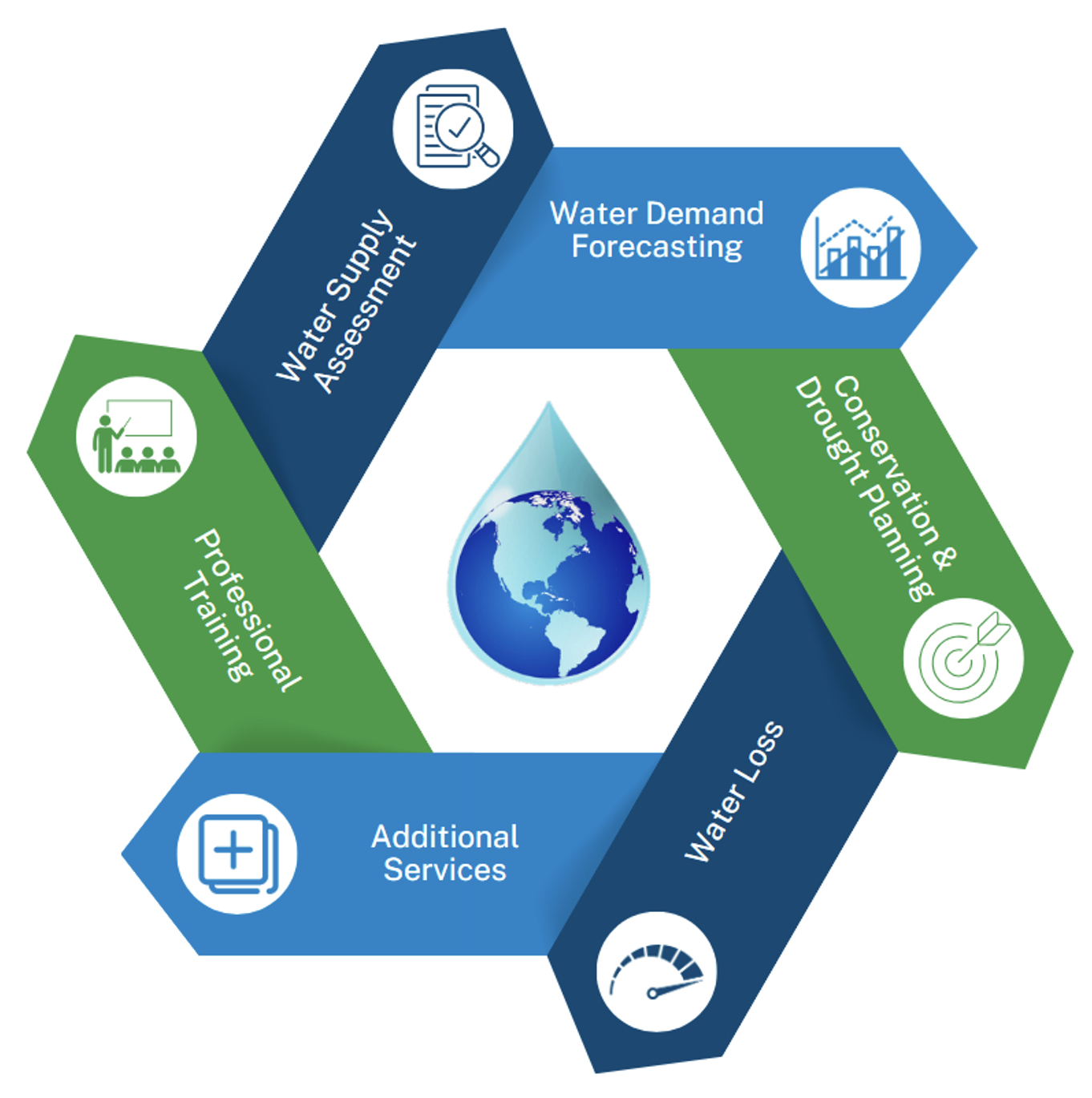
We provide focused consulting services that support effective water management, long-term planning, and defensible decision-making.
For over 30 years, Maddaus Water Management has supported water utilities and agencies in advancing water efficiency and sustainable resource planning. Our work integrates engineering, data-driven analysis, and practical implementation tools to deliver solutions that are technically sound and grounded in real-world applications.
-
MWM prepares long-range, demand projections using its proprietary Demand Side Management Least Cost Planning Decision Support System Model (DSS Model). The DSS Model, officially endorsed by the California Water Efficiency Partnership (CalWEP) in 2004, analyzes water and service area data to develop a detailed demand forecast. MWM has completed more than 500 cost-effectiveness models in over 30 states and internationally, representing a population of over 50 million people.
-
MWM designs custom, pragmatic water efficiency programs using the DSS Model to project impacts on future demand. MWM collaborates with water utility staff to review, select, and incorporate conservation measures to reduce demand, including a review of per capita water use, budgeting, staffing, benefit-cost analysis, and conservation program implementation and evaluation. MWM staff work as an extension of water utility staff capacity for water conservation program planning and implementation. MWM staff members are lead authors for many conservation publications including the International Water Association (IWA) Manual Preparing Urban Water Use Efficiency Plans, A Best Practice Guide and the AWWA M52 Water Conservation Programs – A Planning Manual.
-
MWM conducts training across the country and internationally on water conservation program planning and implementation, benefit-cost analysis, AMI data best practices, and commercial water efficiency audits. MWM has trained more than 1,500 attendees and completed more than 350 field audits to date. Virtual and on-site trainings are available, with audiences ranging from water utility staff and government planners to industry professionals and homeowner’s associations. MWM staff are also the lead trainers of the National Certified Commercial Water Auditor Certification Course, offered though the International Association of Plumbing and Mechanical Officials (IAPMO).
-
MWM provides comprehensive CII water efficiency services, including program planning, facility water assessments, training, and implementation support. MWM has extensive experience with the manufacturing facilities, campuses, food service, HOA’s, agricultural operations, local government and other sectors. Services include customized on-site and virtual training workshops, advanced technical support, data-driven program development using AMI and utility data, and specialized assessment tools that streamline field analysis and reporting. MWM also hosts an annual CII Roundtable for past program participants to exchange insights, discuss emerging trends and technologies, share lessons learned, and collaborate on CII water efficiency challenges and best practices.
-
MWM provides Water Loss Audit and Validation services in compliance with regulatory requirements and industry best practices, including AWWA methodologies and state reporting standards. MWM helps utilities identify apparent and real losses, improve data accuracy, prioritize infrastructure investments, and enhance overall system efficiency. Services include annual audit preparation, validation, performance indicator analysis, and staff training, supported by a California-certified Water Loss Audit Validator on staff. In addition to auditing and validation, MWM develops comprehensive, water loss control programs and implementation roadmaps tailored to operational needs, staffing capacity, and regulatory requirements, including audit procedure development, evaluation of leak detection and pressure management opportunities, meter testing and replacement strategies, and data management improvements. The roadmap establishes performance goals and long-term programs that reduce non-revenue water and improve system reliability and efficiency over time.
-
MWM transforms AMI data into actionable insights that support utility planning, conservation program development, grant applications, and long-term resource management. MWM has developed and enhanced utility programs using Advanced Metering Infrastructure (AMI) technology, including high use notification programs, leak detection and outreach, and outdoor watering detection and enforcement. MWM has a rigorous approach to developing a roadmap for recommended AMI data integrations, including actions to optimize effectiveness of data analysis and reporting systems. MWM has also done substantial work to identify Best Management Practices (BMPs) in AMI data and tool utilization and are lead authors on the 2025 Water Research Foundation Project 5208 Advanced Metering Infrastructure (AMI) Workshop: Better Use of the Systems and Data. In 2022, MWM helped on the AWWA Increasing Consumer Benefits & Engagement in AMI-Based Conservation Programs. In 2022, MWM also authored the EPA Report Improving Water Management Using Advanced Metering Infrastructure Data: A Guide for Facility Managers.
-
MWM provides comprehensive Water Supply Assessments (WSAs) to evaluate whether adequate and reliable water supplies are available to meet the demands of proposed development projects. Assessments consider planned land use, building types, landscaping, projected population growth, water demand forecasts, climate and drought conditions, and utility system capacity to quantify potential supply impacts. MWM works closely with utilities, planners, and developers to support regulatory compliance, inform long-term resource planning, and identify supply and demand management strategies that improve system reliability and sustainability.
-
MWM evaluates and develops conservation-oriented water rate structures that balance water savings objectives with customer affordability, equity, and utility revenue stability. Analyses assess alternatives such as increasing block rates, water budget-based rates, drought pricing, and seasonal rate structures using criteria including projected water savings, customer acceptability, implementation cost, billing impacts, regulatory considerations, and operational feasibility. MWM’s data-driven approach helps utilities identify rate structures that encourage efficient water use while maintaining fairness and financial sustainability.
-
MWM can provide recommendations on community engagement and participation as well as program marketing. MWM can review and create community surveys, develop program collateral, generate creative ideas, assist in structuring events and open houses, provide program marketing materials and provide design and content support for presentations, advertising, and websites.
-
MWM can create custom implementation roadmaps to help water agencies meet indoor and outdoor standards, manage water losses, and support compliance. Roadmaps may include an evaluation of staffing and funding requirements to meet the specific needs of the agency. MWM will review the current program and suggest enhancements to staffing, marketing, measures, and/or Advanced Metering Infrastructure (AMI) data analytics to support long term budgeting and planning efforts.
-
MWM’s integrate spatial analysis with water use, AMI, billing, and land use data to support data-driven conservation planning, program implementation, and regulatory reporting. GIS tools are used to map historical conservation participation, assess outreach equity using socioeconomic overlays, and identify underserved or overrepresented areas to improve program offering. MWM also combines GIS with AMI and landscape data to identify high-priority conservation opportunities, including overwatering clusters, turf-to-landscape conversion targets, and high-use CII customers.
Additional Services

MWM’s Commitment to Sustainability, Recycling, and Other Environmental Matters
MWM maintains a strong environmental ethic focused on reducing its carbon footprint. Since its founding in 1995, MWM has operated as a fully virtual company, eliminating commute-related impacts and reducing vehicle travel by an estimated 62,400 miles and approximately 16 tons of CO2 emissions annually.
The firm also integrates sustainable practices into daily operations by prioritizing virtual meetings, electronic document review, digital approvals and invoicing, recycling, and reduced paper use through electronic note-taking and reusable tools. MWM employees also actively test and promote water-efficient technologies in their homes and professional work.